The logistics and e-commerce world are changing at warp speed, and there is one innovation that truly disrupts everything: Autonomous Delivery Drones. With e-commerce demand ever-increasing, companies are considering that they could need to deliver goods quicker and more environmentally friendly, with less hassle. Autonomous Delivery Drones are becoming an effective solution to change the transportation of goods within cities, rural areas and sometimes inaccessible locations. From faster deliveries to more efficient supply chains, these intelligent flying machines are shaping the future of logistics.
What Are Autonomous Delivery Drones?
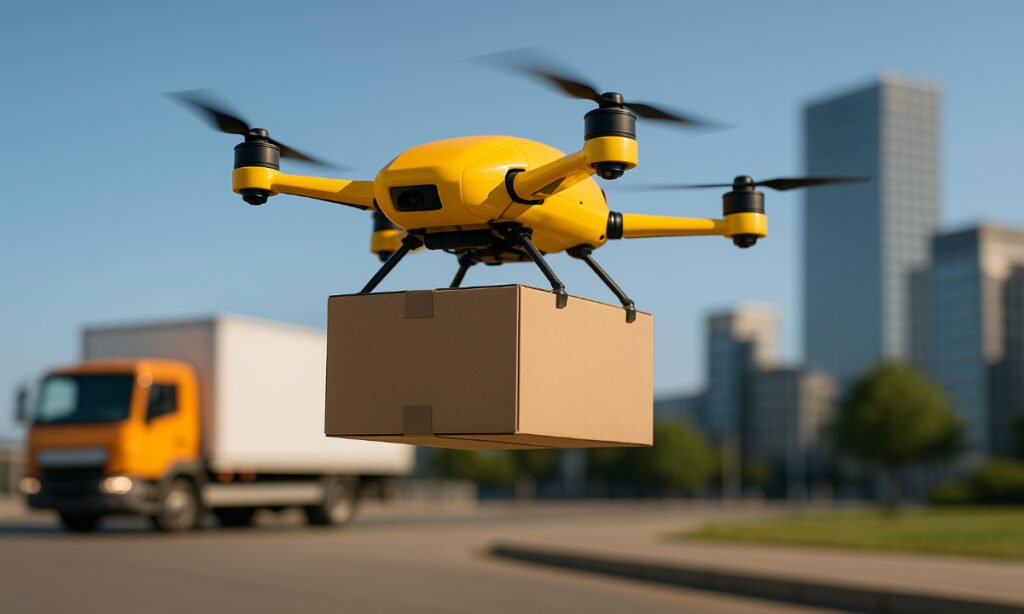
Autonomous Delivery Drones are a type of unmanned aerial vehicle (UAV) that are built to carry packages and deliver them without human contact. With AI-based navigation, sensors, cameras , and precision landing systems, they can take off, fly, and deliver products on their own. These drones are configured to find obstacles and deliver items with high accuracy in complex environments.
Instead of relying on an operator like conventional drones, which theorists control manually, Autonomous Delivery Drones use a combination of real-time data and complex algorithms to make decisions while in-flight. With such a high level of autonomy, companies can scale delivery operations more rapidly and efficiently than human-operated delivery networks.
Also read- AI-Powered Personal Assistants 3.0: The Next Evolution
How Autonomous Delivery Drones Are Transforming E-Commerce
1. Ultra-Fast Delivery Speeds
One of the greatest benefits of Autonomous Delivery Drones is speed. Drones can deliver goods in a matter of minutes, rather than hours, or even days. Numerous online stores are testing out drone delivery for rush orders of groceries, pharmaceuticals and essentials. Drone-enabled delivery systems can drastically shrink delivery windows, allowing customers to get products nearly instantly.
2. Lower Last-Mile Delivery Costs
Delivery in the last mile is the costliest part of the supply chain. It’s a matter of dealing with traffic, gas, vehicle upkeep, and the cost of labor. Autonomous Delivery Drones eliminate many of these costs. They need;
- No drivers
- No fuel
- Minimal maintenance
- Shorter delivery routes
This allows companies to reduce costs — and give customers speedier, more dependable service.
Sustainability and Environmental Impact
With sustainability high on the agenda for consumers and businesses alike, Autonomous Delivery Drones are a much greener option compared to the traditional delivery vehicles reliant on fuel. Running fully on electricity, drones emit zero direct emissions, contributing to the reduction of air pollution and fossil fuel dependency. Route-optimized, they fly in straight lines with none of the ‘stop-and-go’ motion of traffic jams that limits their efficiency, so they are much more energy-efficient than trucks or vans.
This efficiency not only saves time but also reduces the average power consumption of the overall delivery. In the case of expanding metropolises and eco-conscious brands looking to reduce their carbon impact, drone technology in logistics systems can provide notable decreases in greenhouse gases and serve long-term sustainability objectives.
Also read- Best AI Tools for Businesses in 2025
Key Technologies Powering Drone Deliveries
1. Artificial intelligence and machine learning
AI enables drones to make decisions on the fly—identifying obstacles, rerouting, and landing safely. ML methods facilitate a continuously enhanced navigation precision and delivery performance.
2. GPS and Geo-Fencing
GPS provides for precise tracking and route management, while geo-fencing confines the drones to designated airspace, mitigating risks to security and privacy.
3. Advanced Sensors and Cameras
Image Now high-resolution cameras, LIDAR sensors and infrared systems allow drones to recognize terrain, to steer clear of buildings and other obstacles to maintain smooth, safe routes of flight.
4. Cloud Connectivity
Drones are linked to cloud networks nowadays to enable real-time data updates, swarm management, flight logs, and system health monitoring. That allows for integrated control and interfacing with e-commerce systems.
Challenges in Adopting Autonomous Delivery Drones
Notwithstanding their bright prospects, Autonomous Delivery Drones can be confronted with challenges such as:
1. Airspace Regulations
Drone flights are subject to strict aviation regulations in many countries. Regulations for commercial operations of drones, particularly in urban environments, are still being crafted by governments.
2. Safety Concerns
The performance of a drone can be affected by weather conditions, a malfunctioning component, and electronic jamming. Making them crash-proof is necessary for mass adoption.
3. Privacy Issues
Residents may be alarmed by drones with cameras, and the issues of privacy have been raised. To keep trust, there will need to be some transparency about the policies and the encryption systems.
4. Limited Payload Capacity
The majority of drones are capable of carrying lightweight to medium packages. For smaller packages, we’ll still have the drone method, but for big items, old delivery methods will still be necessary.
Industries Benefiting from Autonomous Delivery Drones
1. E-Commerce and Retail
Amazon, Walmart and large logistics companies, among others, are already trialing drone deliveries to accelerate orders for customers.
2. Healthcare
Drones are now transporting medical supplies, vaccines and emergency equipment to far-flung regions.
3. Food and Grocery Delivery
Restaurants, grocery stores, and delivery services rely on drones to deliver fresh goods more quickly.
4. Manufacturing and Warehousing
Companies deploy drones to carry parts, tools and small goods across sprawling industrial sites.
The Future of Autonomous Delivery Drones
Autonomous Delivery Drones are anticipated to be a ubiquitous sight in cities over the next few years. With advancements in technology, they would be carrying heavier payloads, flying longer distances, and integrating with smart-city infrastructure. Upcoming capabilities include:
- Drone landing hubs on rooftops
- Automated drone highways
- Instant 24/7 delivery networks
- Fleet management driven by AI
With more investment and innovation, drone delivery will soon be just as reliable as today’s courier services—only faster and more efficient.
FAQs
1. What are Autonomous Delivery Drones?
These are AI-driven UAVs that are built to deliver packages without human intervention.
2. Is there a maximum distance for drones?
Most drones can deliver packages within 15–30 minutes depending on distance and weather conditions.
3. Is it safe to use drones for delivery?
Yes, Drones are equipped with sensors, are AI-navigated, and have automated safety mechanisms to prevent them from crashing into things and making sure the deliveries are secure.
4. Is it possible to use drones for heavy delivery?
Presently, most packages are drone-delivered in small to medium sizes, but new models are being designed to carry heavier items.
5. Is the drone delivery process environmentally sustainable?
Yes, they are electric-powered, they have no emissions, and they help reduce traffic.
Conclusion
Autonomous Delivery Drones are revolutionizing the future of logistics and e-commerce with extraordinary agility, cost-efficiency and sustainability. Although barriers such as regulations and technical challenges still exist, the multitudes of innovations are already making the mass utilization a reality. As more business take advantage of this new delivery option, shoppers will enjoy faster, greener and more convenient shopping experiences. The age of intelligent, autonomous delivery is just getting started—transforming logistics around the world one drone at a time.