The technological world is changing drastically as quantum computing and AI are moving faster than ever. Although AI has been the most dominant innovation topic for the past 10 years, quantum computing is now emerging as a computational superpower that can tackle complex tasks that classical machines can barely keep up with. When these two technologies combine, we get Quantum Computing & Quantum-AI Convergence — a breakthrough that will redefine intelligence, discovery, and problem solving for decades to come.
This convergence is one of the most surprising shifts in 21st-century technology. It combines the probability-driven structure of quantum computing with the pattern-recognition abilities of AI to develop computation models with abilities that were previously deemed impossible. As enterprises investigate digital transformation and advanced automation, this twin-force technology could enable them to harness efficiencies, insights and innovations on a scale never before imaginable.
The funding for quantum research has been picking up speed over the last few years with governments and global corporations realizing that their convergence of quantum and AI systems could be the digital infrastructure of the future. Startups, cloud providers, and academic institutions are now competing to develop real-world quantum-AI frameworks that can be tested and utilized.
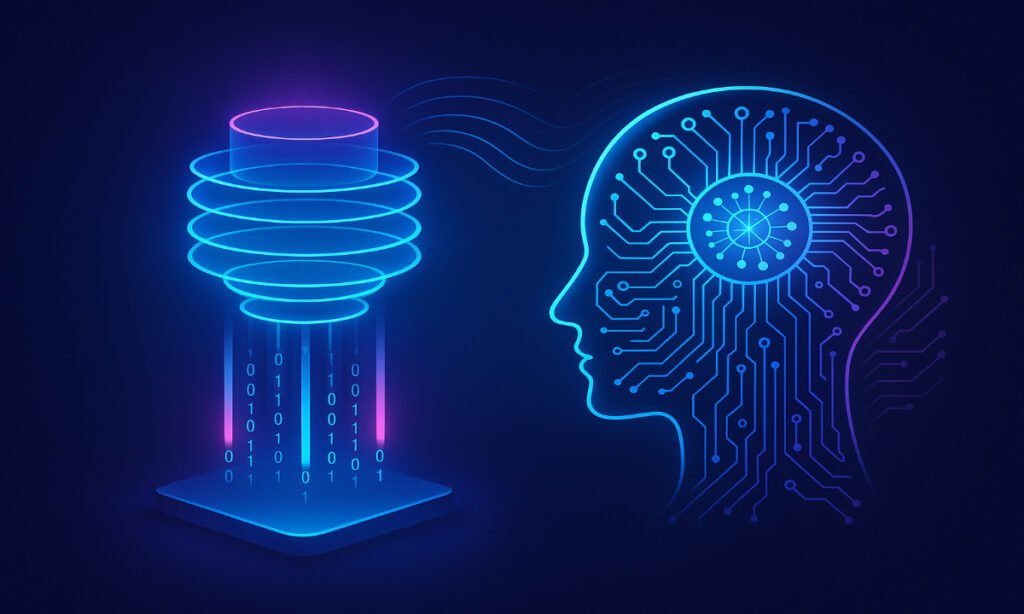
Understanding Quantum Computing
Quantum computation is based on the principles of quantum mechanics and involves the use of qubits in place of classical bits. As opposed to conventional bits that represent a singular value of either 0 or 1, qubits take advantage of superposition to be represented by multiple values at the same time. They can also be entangled, which lets them be linked in ways that classical computers can’t reproduce.
Due to these rules, quantum computers can :
- Process massive datasets in parallel
- Solve optimization problems with millions of variables
- Simulate molecules, materials, and environments with unprecedented fidelity
- Crack strong encryption — or aid in creating post-quantum security
This means quantum computing is well-suited to enabling next-generation AI models that are far more computationally expensive. Quantum processors are designed for multivariable analysis, which can achieve unparalleled parallelism that no traditional processors could come within a mile of, not even advanced GPUs. And so quantum systems can be used to solve scientific, mathematical and industrial problems that either can’t be solved at all today, or would take hundreds of years for classical computers to solve.
As the hardware continues to evolve, the hybrid computation that integrates classical and quantum resources is gaining traction. These hybrid platforms provide scientists the ability to prototype quantum algorithms, experiment with machine learning pipelines, and incrementally scale their use cases as quantum hardware matures.
Also read- Crypto Payment Rails in Mainstream E-Commerce
What Is Quantum-AI Convergence?
Quantum-AI Convergence denotes the merging of quantum computing with artificial intelligence to enhance the speed of learning of AI, increase the predictive accuracy, and let AI operate on much more complex data structures. Although AI benefits enormously from having massive datasets and powerful processors to work on them, traditional computing is beginning to buckle under the escalating computational requirements of deep learning, transformer models, and running in real-time. Quantum computers, due to the parallelism of nature, are natural complements to the new AI.
Why Quantum-AI Matters Now
The world is experiencing exponential growth in data. Models based on AI are becoming larger, more complex, and more computationally intensive. New problems — including drug discovery, climate modeling, cyber-security, and autonomous systems — require computational tools that go beyond traditional hardware.
Quantum-AI systems are designed to:
- Train machine learning models faster
- Explore exponentially more possibilities
- Improve optimization and forecasting
- Enhance accuracy in real-time decision-making
- Accelerate scientific breakthroughs
When combined as Quantum Computing & Quantum-AI Convergence, properly implemented, it can dramatically outperform classical AI systems by a factor of magnitude.
Also check- Micro-Drones for Home Security & Indoor Mapping
How Quantum Computing Accelerates AI
1. Ultra-Fast Machine Learning Training
Training deep learning models may be sped up using quantum computers by processing a multitude of parameters in parallel. Quantum-enhanced algorithms, such as Quantum Support Vector Machines (QSVMs) and Quantum Neural Networks (QNNs), may transform areas that depend on massive-scale learning.
2. Superior Optimization Capabilities
Classical systems are notoriously bad at tackling optimization problems — such as routing, scheduling, and supply chain planning. Quantum-assisted AI can evaluate tens of millions of possibilities in seconds, leading to better solutions faster.
3. Enhanced Pattern Recognition
Quantum algorithms can identify secret patterns or correlations in data sets, that classical algorithms are not able to do efficiently . This makes better predictions in finance, cybersecurity and healthcare.
4. Solving Scientific Simulations
Quantum-AI systems run chemistry, genetics, energy materials, or climate models with breathtaking fidelity. This is poised to speed drug research, lower energy bills, and back sustainability.
5. Reinventing Cybersecurity
Already a major player in threat detection, AI quantum-enhanced ones can sift through data patterns more quickly to find vulnerabilities in real time and help design protections against cyberattacks in the quantum era.
Industries Being Transformed by Quantum-AI
Healthcare & Pharmaceuticals
Quantum-AI can model molecules and proteins, accelerating the discovery of potential life-saving drugs. Predictive diagnostics will be more accurate and personalized, transforming patient care.
Finance & Banking
Quantum-enhanced AI can now analyze complex financial patterns in a matter of milliseconds, from fraud detection and algorithmic trading to risk modeling. This has resulted in safer, more data-driven financial ecosystems.
Transportation & Logistics
Route planning, self-driving, and real-time fleet management have all been highly optimized by Quantum-AI. Supply chains are more resilient and energy efficient.
Energy & Climate Science
Quantum simulations assist design new battery technologies, anticipate environmental changes, and maximize renewable energy systems.
Smart Cities & Robotics
AI-powered robotics driven by quantum energy can advance robotics, infrastructure planning, and future city development.
FAQs
1. What is Quantum-AI Convergence?
The combination of quantum computing and AI enhances computation processes in a way that allows for more efficient processing, more accurate predictions, and the solving of more complex problems.
2. How does quantum computing improve the performance of AI?
Quantum computers consider many options at the same time; this enables AI models to train more quickly, predict more accurately, and work with even richer sets of data.
3. Are we going to get rid of classical computers with quantum computers?
No. Quantum computers aren’t built for the average user. Rather, they are complementary to classical systems and are designed to perform specialized, extremely challenging calculations.
4. What are the key use case areas for Quantum-AI?
Healthcare, finance, cybersecurity, energy, transportation, and scientific research are likely to be the most affected.
5. Is Quantum-AI accessible to normal people in this day and age?
Quantum-AI is still under wraps in terms of development, though rapid progress indicates that quantum-AI will eventually be commercialized and made accessible in 2030-2035 with the advancement of hardware.
Conclusion
A new technological revolution dawns with the rise of Quantum Computing & Quantum-AI Convergence. With the increasing power of quantum processors and the ever-growing capabilities of AI, the marriage of these two domains will revolutionize I-OT, drive scientific discovery, and lead to new generations of intelligent systems.
Those who, among the organizations, embrace this fusion earliest will enjoy unprecedented gains: the insights ever quicker, ever more accurate, and answers to questions once deemed unanswerable. “The future of computing isn’t just faster — it’s smarter, deeper and, ultimately, quantum-powered.”