With artificial intelligence development moving at an extraordinary pace, the need for computing power has never been greater. AI models are getting larger, smarter, and more complex, but they also require massive amounts of computing to train and run. This dramatic increase in power demand has prompted myriad organizations to reevaluate their digital infrastructure, resulting in the emergence of the Green Data Center, arguably the most critical sustainable trend within the IT industry today. And tech titans such as Google, Microsoft, Amazon, Meta, and Apple are pouring billions into these more sustainable buildings to do just that: reduce emissions, curtail energy waste, and create a more sustainable digital future.
The energy cost of AI is becoming an increasing worry globally. Large data centers that run AI systems use vast amounts of electricity, and in many places, a significant portion of the electricity they consume still comes from fossil fuels. Reports indicate that the worldwide data center industry’s energy consumption could rise to consume as much as 8% of the world’s energy by the year 2030, unless some measures are taken. This means that green, energy-saving, and carbon-neutral operations must be more than just a choice – they must be seen as a responsibility.
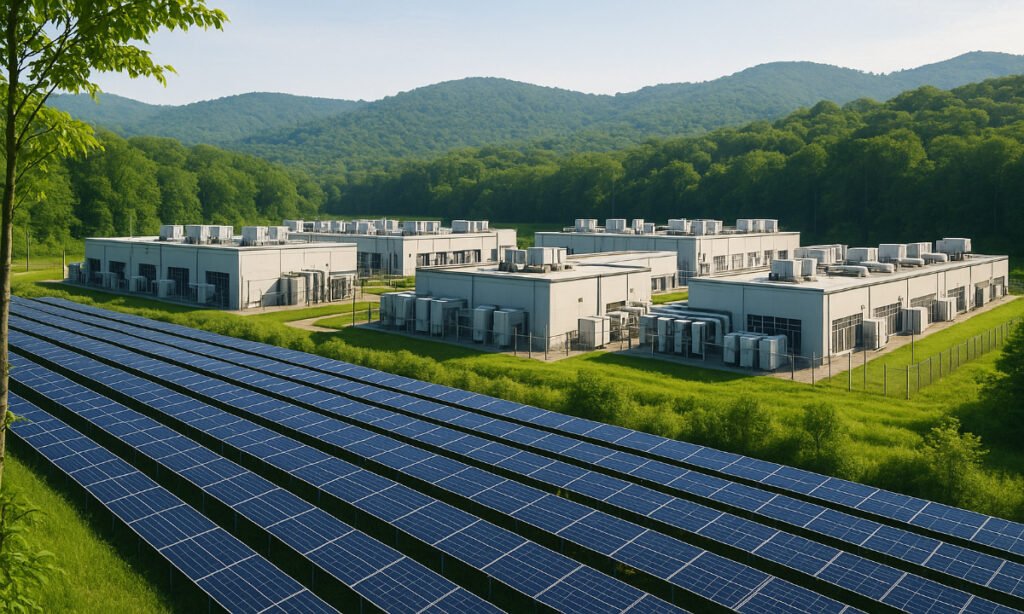
Why AI Needs Green Data Centers
There is a difference in AI workloads and traditional digital services. They demand intense computation via GPUs, enormous storage capacities, and high-speed cooling. Training a large AI model can use as much electricity as hundreds of homes over months. The solution just has to be sustainable, or else the environmental impact will be great.
Green Data Centers seeks to address that by:
- Energy usage consumption relief
- Adopting renewable energy sources
- Using renewable energy sources
- Adopt smarter cooling practices
- Implement smart cooling systems
- Improve the overall efficiency of operations
- Maximizing operational efficiency
- Reduce e-waste and carbon emissions
- Reduce e-waste and carbon footprint
That makes them the backbone of sustaining AI growth.
Also read- Quantum Computing & Quantum-AI Convergence
How Tech Giants Are Transforming Data Centers
1. Going 100% Renewable Energy Source
- Big companies are swiftly making the switch to clean electricity:
- Google has committed to powering all its data centers with 24/7 carbon-free energy by 2030.
- Microsoft is aiming to operate as a carbon-negative company by 2030 and uses wind and solar power for some of its operations.
- Amazon Web Services has also emerged as a leading corporate purchaser of renewable energy.
- Solar farms, offshore wind installations, and hydropower plants are now being paired directly with data centers to power AI workloads with clean instead of dirty energy.
Also check- Micro-Drones for Home Security & Indoor Mapping
2. High-Efficiency Cooling Technologies
Cooling a data center can consume as much as 40% of its power.
Tech Giants Are Experimenting With Extraordinary Methods of Cooling to Ease That Enormous Burden: Here’s a look at how some of the major players are handling the heat.
- Liquid immersion cooling, in which high-performance computers are submerged in a liquid that does not conduct electricity.
- AI-enhanced cooling employing machine learning to minimize energy consumption.
- Free-air cooling is the phenomenon of using cold outdoor air to replace much of the indoor air-conditioned cooling.
- Undersea or underwater Datacenters, subsurface Datacenters, or ocean-based Datacenters that use seawater cooling.
- Microsoft has established a prototype underwater datacenter and these tests demonstrated that the datacenters are energy efficient, reliable and simple to maintain, further reinforcing the company’s belief that in the near future, we will be able to operate our datacenters under the sea.
3. Energy-Efficient Server Architecture
An increasing number of companies are presently upgrading their server hardware to deliver more performance per watt. Custom AI chips, ARM-based CPUs, and energy-efficient GPU clusters reduce power consumption dramatically while boosting performance. Tem has built specialized chips for AI workloads, as have Google and Amazon.
With this change, the waste heat is reduced, the cooling needs are reduced, and the overall power consumption is reduced.
4. Automation & AI for Energy Optimization
The irony of the situation is that data centers are under threat from the very technology that will see them become obsolete – AI.
Use of AI-driven applications, including:
- Predict electricity demand
- Handle server loads
- Detect inefficient equipment
- Adjust cooling levels
- Ride the waves of renewable energy availability
Using AI to manage cooling and ventilation has resulted in a 40% reduction in energy use at some facilities, Google said.
5. Reusing Heat from Data Centers
Some businesses are looking for ways to capture and reuse heat from servers. In Europe, data centers are now feeding residential heating systems or heating public swimming pools. This is how we can turn big computing centers into circular energy communities.
6. Water Conservation Initiatives
Water-based cooling systems are known to consume millions of litres every year.. To reduce water waste:
- Microsoft is now employing adiabatic cooling systems.
- Google is pursuing freshwater-free cooling with industrial sewage.
- Amazon is trialling an air-only cooling solution in arid regions.
Water stewardship is poised to be a key trend in sustainable data center design.
Why Green Data Centers Are the Future
Green Data Centers aren’t a nice-to-have ; they’re a must-have. As AI models proliferate and cloud demand surges, the challenge facing companies is how to scale without devastating the planet. Sustainable infrastructure lowers emissions, and also reduces operating costs, improves energy efficiency, and assists businesses in complying with global environmental regulations.
And there are higher sustainability regulations being enforced by governments around the world, which is putting pressure on tech giants to speed up their green promises. With AI’s growing footprint every year, green data centers are expected to become the standard for future digital ecosystems.
FAQs
1. What are green data centers?
A green data center is a type of data center that employs energy-efficient technologies and uses renewable energy to power its operations to reduce carbon emission and other environmental impact.
2. Why are tech giants going green in data centers?
Tech giants require sustainable infrastructure for AI growth that brings down energy costs and delivers on global carbon-neutral ambitions.
3. What kind of technology does a green data center use?
Renewable energy, better cooling systems, energy efficient chips, and AI-based power optimization all play a role in greener operations.
4. How do green data centers minimize the carbon impact of AI and green centers?
They run on clean energy, waste less energy cooling, and they roll it all up in a bow of efficiency so that AI work consumes less energy and emits less pollution.
5. Do green data centers cost more?
Upfront costs may be higher, but operating and energy costs over the life of the project are greatly reduced.
Conclusion
Green Data Centers are the future in sustainable technology. With AI expanding into every industry, computing infrastructure that is good for the environment is needed now more than ever. The tech giants are spearheading the trend, by purchasing or generating clean energy, optimizing cooling systems, designing more-efficient chips and using AI for energy management. Together, these advances are transforming data center operations and lowering the global carbon footprint of AI.
The movement toward Green Data Centers is not simply a fad – it is an essential part of constructing a clean, intelligent and sustainable digital world.