The digital world is in the midst of a massive transformation as the line between physical and virtual spaces is quickly blurring. Extended Reality is central to that evolution, a strong umbrella term for Augmented Reality (AR), Virtual Reality (VR), and Mixed Reality (MR). These immersive technologies are beginning to change the way we work, learn, collaborate, shop, train, and even interact with digital information.
Extended Reality is a lot more than headsets and games. It has evolved into a strategic enterprise solution transforming industries such as healthcare, education, architecture, retail, manufacturing, marketing, entertainment and remote collaboration. As companies ramp up digital transformation, Extended Reality demand is soaring, offering more natural interfaces, data visualization, immersive training and real-time simulation.
In this article, we discuss how Extended Reality functions, applications in the real-world, industry penetration, advantages, problems, and future possibilities — demonstrating how XR is becoming the cornerstone of the digital future.
Understanding Extended Reality
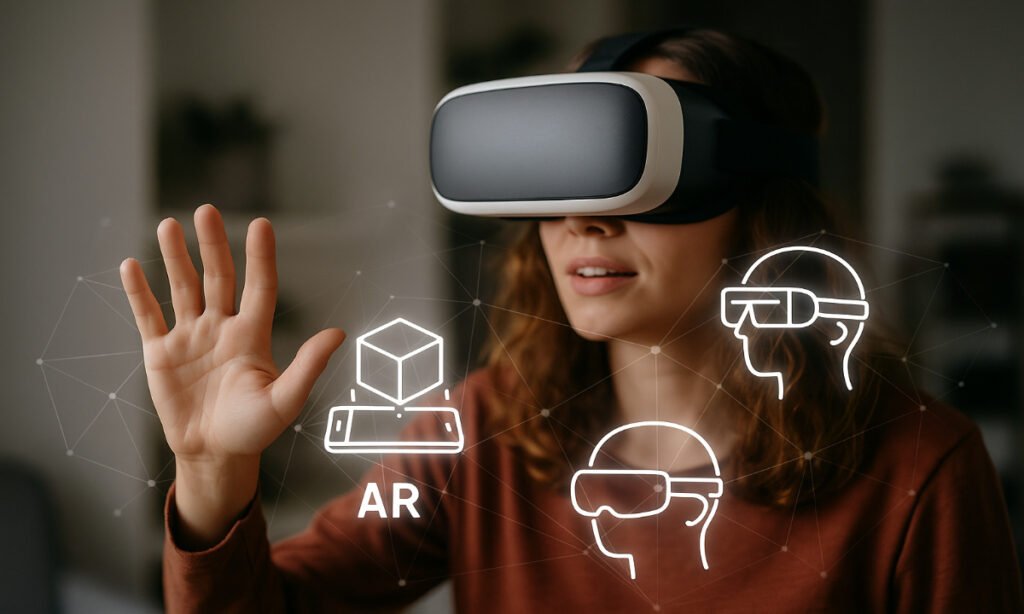
Extended reality (XR) is a continuum of immersive technologies that comprises the aspects of both the physical world and virtual world. It consists of:
1. Augmented Reality (AR)
AR superimposes digital content onto the real world. Examples include mobile AR apps, smart glasses, and interactive 3D visualizations in education, retail, and factory work. What you get is users in the physical world, but with related digital enhancements providing context and clarity.
2. Virtual Reality (VR)
In virtual reality the user is placed in a completely simulated environment. Users can visit virtual worlds, participate in training simulations, or meet in digital workspaces, all from VR headsets. It is extremely useful for industries where live training is expensive, dangerous, or unavailable.
3. Mixed Reality (MR)
MR combines real and virtual world elements in real time and allows users to interact with digital objects as if they are physical. This is frequently utilized in mechanical engineering, 3D product design, surgery planning, remote support and group processes, among others.
Extended Reality combines these experiences in a seamless environment, enabling enterprises to mix virtual simulation, digital overlays, and interactive applications dependent on the scenario.
Also read- How to Use TimeWarp TaskUs (Employee Guide)
Why Extended Reality Is Becoming a Digital Imperative
The growth in Extended Reality is being shaped by a number of leading trends in today’s enterprise and consumer markets.
1. More Human- Technology Interactions Are Intuitive
XR goes off the screens and keyboards to allow more natural methods of interaction like gestures, voice commands, on-the-fly movement, and spatial recognition.
2. Immersive Simulation and Training Increasing Demand
XR minimizes training hazards and expenses by providing high fidelity simulations for pilots, surgeons, members of the military, manufacturing technicians, and emergency responders.
3. Shift to Hybrid and Telework
Virtual collaboration tools built on extended reality technology establish digital workspaces in which employees — as avatars themselves — work together on 3D models,
brainstorm visually, and collaborate.
4. Emergence of the Experience Economy
Consumers are looking for more immersive, personalized, and interactive experiences—whether they’re shopping, traveling, gaming, or getting entertained.
5. Progress in Hardware & Cloud Infrastructure
The new generation of XR headsets, cloud rendering, AI-enhanced tracking, and 5G/6G connectivity make immersive experiences more realistic and inclusive.
Also check- Blockchain & Web3: The Future of Decentralized Innovation
Real-World Applications of Extended Reality
Extended Reality is redefining industries through useful, high-impact applications.
1. Healthcare & Medical Training
XR enables surgeons to rehearse procedures, understand intricate anatomy, and meticulously plan surgeries. Medical students can practice in no-risk environments, shortening learning curves and saving lives.
2. Education & Learning
Schools are using XR to animate their lessons. They can travel to ancient cultures, do science experiments in a virtual lab, or engage with 3D models—helping them retain and stay focused.
3. Retail & E-Commerce
Extended Reality offers virtual try-on, digital showroom, product visualization and shopping experiences that help customers to have more confidence in products and drive up conversion rates.
4. Manufacturing & Industrial Operations
Technicians rely on AR smart glasses for watching real-time instruction, assembling guidance, maintaining machinery and accessing support remotely. XR enhances production speed while minimizing human mistakes.
5. Real Estate & Architecture
VR and MR facilitate virtual tours around properties, 3D modeling of building plans and room design – energy-saving tools that help make your dream home a reality.3d modeling Throughout the entire home construction project.
6. Entertainment & Gaming
From VR concerts to AR-enhanced sports games, Extended Reality is transforming interactive entertainment and storytelling that draws you in.
7. Remote Collaboration & Digital Workflows
Teams can gather in virtual spaces, work on 3D prototypes, and brainstorm in ways traditional video calls just don’t allow.
Benefits of Extended Reality for Enterprises
Any organization implementing Extended Reality is able to unlock strategic competitive advantages in the form of:
- Increased productivity and efficiency
- Lowered risks in training and reduced operating expenses
- Keen customer engagement
- 3D data visualization for faster decision making
- Higher retention and learning by doing
- Improved precision in design, engineering and simulation
- Better remote work and collaboration capability
Extended Reality enables new digital experiences that are more natural, compelling and scalable than traditional 2D interfaces.
Challenges in Adopting Extended Reality
While expansion has been rapid, some challenges remain to be addressed:
- High upfront cost of hardware or integration
- Requirement for specialist skills and development of XR content
- Fatigue of users from extended sessions in XR
- Concerns with privacy and data protection
- Hardware Constraints, for example Battery life or Weight
- Organizational inertia in adopting new technology
With the advancement of XR hardware, and the growing enterprise adoption of the technology, these barriers are diminishing every year.
FAQs
1. What are the applications of XR?
Extended Reality is leveraged in Training & Education, Design and Remote Support, Simulation, Gaming, Retail, Healthcare, and Immersive Digital Experiences.
2. Should we compare AR and VR to Extended Reality?
Extended Reality (XR) is a generalized term which includes AR, VR and Mixed Reality (MR) and covers a wide variety of immersive technologies.
3. How does Extended Reality enhance training at work?
It enables risk free and realistic environment to increase retention and engage in hands-on learning beyond physical boundaries.
4. Do companies need pricey gear for XR?
No, not necessarily. Quite a few XR applications run on smartphones and tablets or light AR glasses, while VR headsets provide more sophisticated immersion.
5. What are the top industries that are leveraging Extended Reality?
Key sectors such as healthcare, manufacturing, education, retail, architecture, gaming, and even enterprise collaboration are among the biggest XR adopters.
Conclusion
Extended Reality is revolutionizing the way we engage with digital and physical worlds. By converging AR, VR and Mixed Reality within one integrated immersive platform, XR is transforming experiences within industries and enabling new use cases for training, collaboration, design, customer engagement and enterprise operations. As the pace of digital transformation picks up, Extended Reality is poised to further broaden its applicability, empowering business with a tool to drive innovation, efficiency, and immersive digital experiences.
Whether it’s for simulation, education, visualization or amusement, Extended Reality is a vanguard for a world in which technology will be more natural, immersive and focused on people than it has ever been.