The world of software development is being transformed by one of the largest technological shifts in history. For years, developing software meant large teams of developers working for months, followed by cycles of testing, debugging, and shipping. But now a new rotation is appearing — autonomous coding AI instead of traditional dev teams. These two AI technologies plan, write, test, and deploy code at a remarkable pace, and in many ways, they are better and more consistent developers than humans.
As companies strive for greater automation, shorter release cycles and lower costs, autonomous coding AI is gaining traction as a leading candidate to meet these demands. These systems don’t replace creative or strategic thinking- they remove tedious tasks and enable rapid development in ways that were previously thought to be unimaginable. In this article, we look at what autonomous coding AI is, why companies are embracing it and what the future looks like for developers in a world where software is driven by AI.
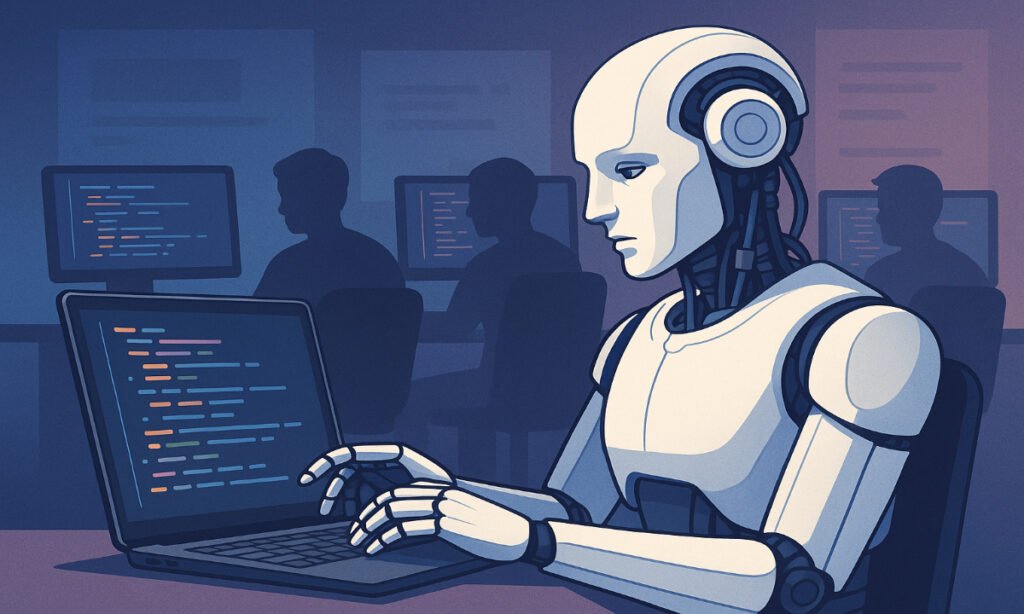
What Is Autonomous Coding AI?
Autonomous coding AI is a subfield of AI and software engineering that deals with the development of autonomous agents capable of writing complete software applications with minimal or no human assistance. Unlike previous generations of tools, which made suggestions or supported autocompletion, AI today can:
- Understand high-level requirements
- Divide tasks into steps
- Produce clean and operational code
- Automatically debug problems
- Run tests on the code
- Enhance the performance
- Release applications
This is what makes autonomous coding AI so much more powerful than conventional developer tools. These AI agents operate as standalone developers — they think, plan, and iterate on their outputs.
The big focal keyword is ‘autonomous coding AI disrupt traditional dev teams’, and this change of focus is rapidly taking over the tech scene.
Also read- AI Tools for Zero-Click Customer Support
How Autonomous Coding AI Works
Autonomous coding AI leverages a combination of machine learning, natural language processing, and agentic architecture to think and function a human developer would, but at a scale and speed that is simply unattainable. This is what it does:
1. Task Planning and Breakdown
The AI begins by decoding user instructions such as Build a landing page with authentication
and divides these into coherent units of work such as UI design, API construction, routing, database integration, and so on.
2. Code Generation in Real Time
Having the list of user tasks, the AI then generates the source code in corresponding programming languages. Unlike normal devtools, it supports complex logics, configurations and frameworks.
3. Autonomous Debugging
When there are problems, the AI determines the root causes, rewrites sections of code, and tests fixes autonomously.
4. Testing and QA
Unit tests, integration tests, and performance tests are generated for today’s AI models without human involvement.
5. Deployment
Eventually, AI can launch apps on cloud platforms like AWS, Vercel, or Netlify and also track performance.
This end-to-end pipeline approximates a lean dev team—except the artificial intelligence has no fatigue, and can run at near instant speed 24/7.
Also check- What Is qkfzzu1lbnvinhp4dlhz? Meaning, Uses & Complete Guide
Why Companies Are Choosing Autonomous Coding AI
The traditional developers team voice is restaurants across the globe are currently being left in the dust, with autonomous coding AI set to take over due to massive benefits.
1. Faster Development Cycles
Now you can do in hours what used to take weeks with Software Runs Red and Buildkite’s new SaaS service Codesys. AI enables faster prototyping, features rollouts, and debugging.
2. Great Uplift in Cost Reduction
Firms can trim the size of their teams, bring fewer tasks offsite and sidestep lengthy development delays.
3. Improved Efficiency
Repetitive tasks, such as documentation updates, writing tests and fixing bugs, are fallen away by AI.
4. Consistency and Accuracy
It doesn’t tire out or get distracted like a human,” said Hudson. It provides a consistent style, minimizes errors, and enhances efficiency.
5. Accessibility for non-developers
Entrepreneurs, small businesses, and creators can now build an app without learning how to code. AI drastically reduces the cost of software production.
Scalable
AI, by comparison, can do thousands of these operations at a time, making enterprise-level software development faster and smoother.
Will Developers Become Obsolete?
One big question is whether the AI coding that now replaces traditional dev teams means developers will lose their jobs. The reality is fuzzier.
AI excels at:
- Repetitive tasks
- Writing boilerplate code
- Debugging
- Running tests
- Optimizing performance
But humans still lead in:
- Creative problem-solving
- Architecture planning
- Security design
- Product vision
- Ethical decision-making
- Complex integrations
Autonomous coding AI does not replace developers outright but redefines their role. Developers are architects, supervisors, and collaborators—directing AI, vetting output, and concentrating on big-picture engineering.”
Industries Being Transformed
1. SaaS and Startups
Small teams are now able to ship products rapidly with AI as their main developer.
2. E-Commerce
Custom features, automation and store-front updates are developed quicker.
3. Enterprise IT
AI enables faster digital transformation, modernization and automation of workflows.
4. Healthcare
AI-written software for secure data systems, patient apps, and clinic management solutions.
5. Finance & Banking
AI makes it possible to build secure financial platforms and compliance-ready applications quickly.
The rate of adoption is escalating, proving that coding AI autonomously is no longer a field of experiment—it is a must-have.
Top Autonomous Coding AI Tools
Several cutting-edge platforms are leading the charge:
1. Devin (Cognition Labs)
Previously described as the the first AI software engineer, Devin manages multi-layered engineering work from end-to-end.
2. GitHub Copilot Workspace
Make features and fixes bugs and automate complete projects using guided workflows.
3. Replit AI
A robust end-to-end AI agent that constructs, experiments with, and releases entire applications.
4. BuildAI
Enables non-technical users to build entire software by simply describing what they want.
5. Sourcegraph Cody
A developer-first AI that has contextual awareness of entire codebases, and can scale to make massive automated changes.
These are just a few examples of how autonomous coding AI replacing traditional dev teams is not some far off future — it’s happening now.
FAQs
1. What is autonomous coding AI?
Software that can plan, write, test, and deploy itself automatically with little human input.
2. Are developers going to be replaced by AI?
Not really. They complement—repetitive tasks are taken over by it, but humans still dominate in design, architecture and strategic engineering.
3. Can you trust AI generated code?
That’s because today’s autonomous AIs test and debug code as they write it, in real-time, for a very high level of reliability.
4. Is this applicable to small business?
Definitely—AI makes development for startups a lot less costly and time-consuming.
5. Which industries have Autonomous coding AI?
SaaS, fintech, healthcare, e-commerce, enterprise IT, and more.
Conclusion
Self-coding AI is taking over the software industry. It likely will not put software developers out of work, but it is changing the software development process — making development cheaper, faster and available to everyone. That’s because as start-ups replace traditional dev teams with autonomous coding AI, the future of software will be faster, more innovative and more efficient than ever. The next era will be led by developers who embrace AI over those who turn away and risk falling behind.
The transition is upon us, changing the very fabric of software creation.