Robotics enabled by AI is poised to be one of the most disruptive aspects of modern industry. Artificial intelligence with sophisticated robotic systems is bringing higher levels of automation, efficiency and operational intelligence. All that once took human monitoring and manual coding can be done by self learning robots that understand their space, make decisions, foresee consequences, and respond to real-time shifts.
Today, AI robotics is at the core of next-generation automation in production, logistics, healthcare, agriculture, construction, and consumer services. Businesses are now moving away from traditional machines and into intelligent robotic ecosystems where they can improve quality, reduce costs, and get work done in ways just not possible before. With AI models becoming increasingly powerful and robot hardware advancing, the world is moving into an era of fully autonomous, connected , and intelligent machines.
This article covers how “AI Robotics Works”, what industries are being redefined, its advantages, the hurdles confronted by companies, and the future of smart autonomous automation.
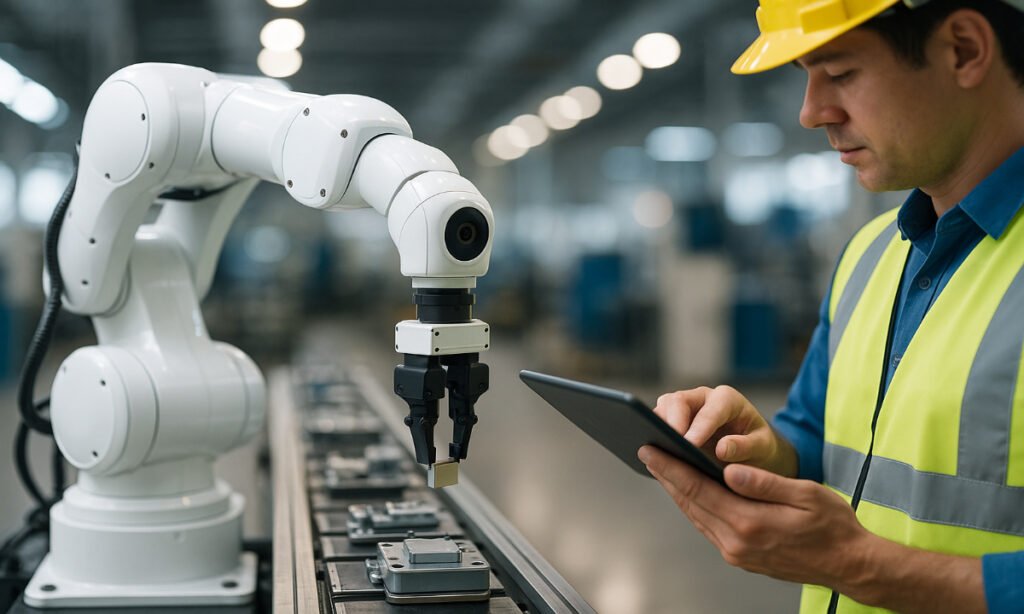
The Rise of AI-Powered Robotics
Robotics powered by AI is the next stage in the development of automation, from sequentially programmed movements to intelligent autonomous devices. “Old school robots executed a fixed set of commands and were very sensitive to anything that went awry.” Today’s AI-based robots, on the other hand, can learn from data, enhance their performance, and adapt to new conditions.
Among the breakthroughs that helped drive the explosive growth of AI-powered robotics:
The Explosion of Machine Learning Capabilities
Neural networks and deep learning techniques have been leveraged by robots also to identify objects, to predict forms, to establish what tasks are performed by the individual, and so on, allowing them also to make predictions about future results.
Huge increases in computing power
Edge computing, GPUs, and specialized AI processors are enabling robots to make decisions in real time without relying on the cloud.
Cheap Sensors and Computer Vision
LiDAR, depth sensors, high-resolution cameras, and thermal imaging provide robots with the ability to see and understand their surroundings with a high degree of precision.
Sophisticated Navigation and Motion Planning
SLAM enables robots to map areas, detect and avoid barriers, and move with complex terrain autonomously.
Emergence of Autonomous Systems
Current robotics systems no longer rely on continuous direct human command; they act, perceive, and learn on their own.
Together, these advances have made AI-powered robotics more approachable, potent, and transformative across the industry.
Also read- AI Governance, Cybersecurity & Post-Quantum Security
How AI-Powered Robotics Works
Robotics is a combination of various technological fields that enable machines capable of provide autonomy, intelligence, and adaptability.
1. Machine Learning and Deep Learning
They make it possible for robots to learn information, identify trends and patterns, interpret the results, and enhance their functionality on an ongoing basis. Robots become better, faster and more nimble with practice.
2. Computer Vision
AI-driven cameras and visual intelligence are used by robots to:
- Recognize objects
- Identify flaws
- Monitor movement
- Understand human signals
- Work in dynamic environments
Computer vision provides situational awareness and sensory intelligence for robots.
3. Natural Language Processing
Service robots, robotic helpers, etc, use NLP to comprehend voice commands, raise queries, and naturally engage with humans.
4. Autonomous Navigation Systems
SLAM and path-planning algorithms enable robots to create maps of an area, navigate through them in a secure mode, and make spatial decisions on the move.
5. Predictive and Prescriptive Analytics
Robots now predict when they will need maintenance, where performance problems may arise, and how they can best arrange their workflows.
Together, these technologies make AI-powered robotics the leading platform for enterprise-grade automation.
Applications of AI-Powered Robotics Across Industries
1. Manufacturing and Industrial Automation
Manufacturers employ AI-enabled robots to optimize every stage of their production. Robots take on such tasks as:
- Precision assembly
- Material handling
- Material transport
- Automated welding
- Real-time quality control
24 /7 production without downtime
AI-powered machine vision also provides defect detection with unparalleled accuracy, minimizing waste and ensuring uniformity.
2. Logistics and Warehousing
AI-driven robotics is redefining the global supply chain:
- Autonomous mobile robots move goods across warehouses
- Automated picking robots use computer vision to locate items
- Robotic palletizers organize shipments
- Inventory drones track stock levels
- Delivery robots and drones handle last-mile logistics
These mechanisms shorten turnaround times and simplify the most intricate of procedures.
3. Healthcare and Medical Robotics
AI-enabled robotics is revolutionizing healthcare today:
- Surgical robots perform highly accurate, minimally invasive surgeries
- Hospital robots deliver medicines and equipment
- AI-based monitoring bots help the clinical team
- Robotic exoskeletons aid in rehabilitation
- Daily assistance from elderly care robots
- They enhance patient care and ease clinician burden.
4. Retail and Customer Service
Retailers are embracing robotics with unprecedented fervour:
- At home, but out of work for a while: a family-cleaning robot from Japan
- Smart shelf-scanning robots monitor inventory
- Robotic shopping assistants
- Checkout automation and customer service AI
Robotics that use AI offer an improved customer experience and store operational efficiency.
5. Agriculture and Smart Farming
Agricultural robots use AI to maximize productivity:
- AI crop analysis
- Precision fertilizer and pesticide application
- Robotic fruit pickers
- Soil condition monitoring
- Automated tractors and harvesters
These systems help farmers produce more with fewer resources.
6. Construction and Infrastructure
AI-powered robotics is making construction faster and safer:
- Autonomous excavation equipment
- Robotic bricklayers and welders
- Structural inspection drones
- 3D-printing robots for building homes
These innovations reduce labor shortages and construction risks.
Also check- Why Sharing Your Phone Number (Like 8393597031) Is Risky — Full Guide
Benefits of AI-Powered Robotics
Robotics with AI has many advantages in various fields:
- Greater output due to non-stop, automatic work
- Uniform good quality with fewer errors and defects.
- Cost efficiency by decreasing the human workload and increasing production
- Safer, particularly in dangerous situations.
- Better scalability, so if your business grows, you can keep up with ease
- Predictive maintenance to prevent expensive downtime
As enterprises pursue digital transformation, AI-enabled robotics is becoming critical for competitiveness.
Challenges in Adopting AI-Powered Robotics
The advantages are clear, but the companies have to deal with several challenges, including:
- Significant initial capital outlay for robotics equipment and facilities
- Integration complexities between legacy systems and AI-based solutions
- Demand for talented engineers, data scientists, and robotics technicians
- Security concerns associated with robotic systems that are interconnected
- Ethical implications of job loss and AI decision-making
Meeting these challenges calls for strategic foresight, strong governance, and sustained commitment to workforce development.
Future Trends in AI-Powered Robotics
The future of robotics powered by AI is far-reaching:
1. Collaborative Robots (Cobots)
Cobots will operate safely with humans in factories, hospitals and warehouses.
2. Autonomous Robotic Ecosystems
Many robots will work together – share data and work in real time.
3. Edge-Based Robotic Intelligence (ERBI)
Robots are expected to process more data locally, resulting in better speed and privacy.
4. Emotion-Aware Robots
Robots will be able to detect human emotion and respond with empathy, thanks to AI-powered sentiment analysis and these are just a few examples.
5. Swarm Robotics
Swarms of tiny robots will undertake complex jobs in farming, emergency response and transportation.
Robotics with artificial intelligence will be smarter, more autonomous, and increasingly embedded in daily life.
FAQs
1. What is AI-powered robotics?
AI-powered robotics enables robots with artificial intelligence to learn, adapt, and make decisions autonomously, not just perform simple preprogrammed operations.
2. Which industries profit the most from AI-driven robotics?
Manufacturing, logistics, healthcare, retail, agriculture, and construction are the greatest adopters of AI-powered robotics for smarter automation.
3. Are AI robots safe? Are AI robots safe?
Yes, modern-day robots have sensors, fail-safe systems, and intelligent decision models, making them safe to be around humans.
4. Will AI robots replace human jobs?
Such machines will replace many jobs, but they will also create new ones, such as in robotics engineering, machine learning, system maintenance, and AI supervision.
5. What is the future of AI in robotics?
The next generation of robots will be fully autonomous, emotionally aware, and will be making decisions in every industry sector.
Conclusion
Intelligent robotics is transforming industries by combining intelligence with automation. From creeping, crawling warehouses to robotic surgeons and smart farming tools, intelligent machines are leading a new era of productivity and innovation. Companies able to leverage AI-enabled robotics are wired not just for efficiency but for competitive advantage in an automated future. As the technology matures, robots will be increasingly collaborative, scalable, and adaptive — building the foundation of the smart industries of tomorrow.