How to Write Humanized Text 4.0 is the go-to text rewriting AI. And now, that is well on the way of being replaced by what experts are calling Agentic AI – one of the biggest shifts taking place today. The discussion on Agentic AI vs Traditional AI is shaping up to be one of the most influential debates in tech as it will dictate how we develop software, automate industries and interact with intelligent machines in the next decade.
Traditional AI has served as the engine for the digital revolution underpinning everything from recommendation engines to facial recognition to voice assistants to predictive analytics. They have big drawbacks, though. They’re not deeply contextual, they can’t multi-step plan, and they require a human to intervene in every action. Agentic AI changes that completely. It brings autonomy, reasoning, and multi-step decision making to AI systems, empowering machines not only to respond, but also to initiate and perform tasks on their own.
This article explains in plain terms the true distinction between the two mindsets and why Agentic AI is the future of automation.
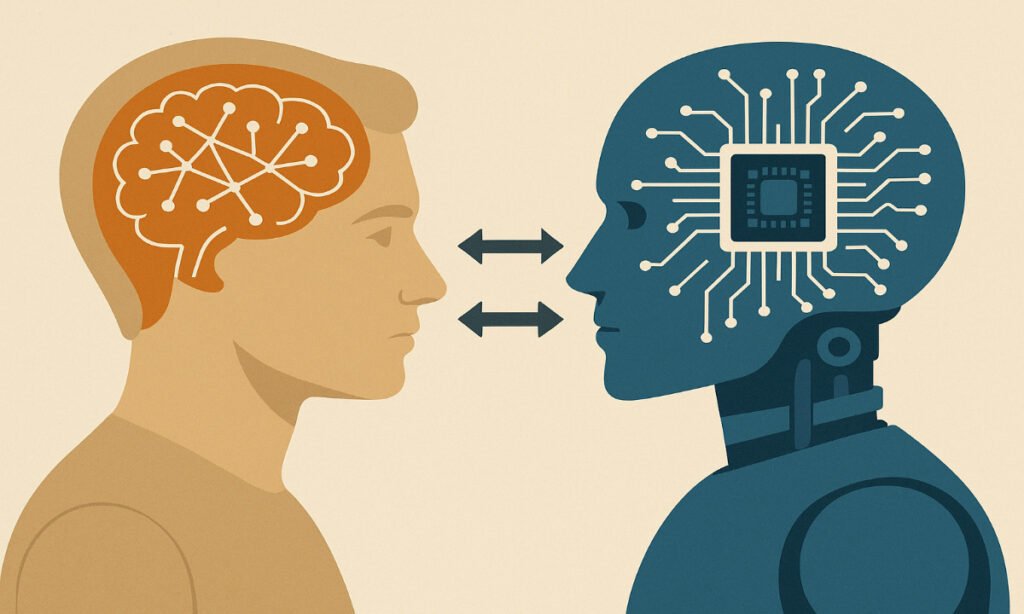
What Is Traditional AI?
The classic AI is similar to, but simpler than, the neural network layer in the sense it has a fixed pattern: input → process → output.
It needs structured data and human instructions to be explicit. See PM of this post for tip how to identify these: Examples include:
- Email spam detection
- Image recognition models
- Speech-to-text systems
- Chatbots with predefined responses
- Recommendation engines
Traditional AI can deliver powerful results, but you should not expect a deep contextual understanding from it. It just regurgitates patterns it has seen in training data. It waits for instructions and does not act on its own.
Also read- Vibe Coding: The New Way Developers Build Software
Key Characteristics of Traditional AI
- Reactive, not proactive.
- Needs human prompts.
- No long-term planning ability.
- Operates with in a fixed set of parameters.
- Optimized for single purpose (narrow AI).
Conventional AI is great at calculations and forecasting—but it can’t “decide” what to do next.
What Is Agentic AI?
Agentic AI is more than just predictions. It acts like a smart agent that can:
- Goal-setting Setting goals
- Planning multiple steps
- Deciding Making decisions
- Performing actions independently
Tracking success and refining Evaluating success and improving
This means the AI is not just reacting—it’s acting.
Examples of Agentic AI are:
- AI that automatically runs your schedule
- Fully automated coding agents that design, write, test and debug software
- AI assistants that work without being endlessly prompted
- Business process agents that analyze KPIs and lead to actions
Agentic AIs construct multi-step answers by utilizing chain-of-thought reasoning, long term memory tools, and planning algorithms. It performs traditional real-world problem solving.
Also check – Amandalaviinia: Meaning, Origins & Creative Influence
Agentic AI vs Traditional AI: Key Differences
1. Autonomy
- Traditional AI: Obedient to commands and rules.
- Agentic AI: Makes decisions and takes actions based on its own goals and reasoning.
2. Capability
- Traditional AI: Good for very narrowly defined jobs.
- Agentic AI: Applies multi-step workflows and creative problem-solving.
3. Learning Approach
- Traditional AI: Trained once and once deployed behaves predictably.
- Agentic AI: Learning as it works, from results.
4. Decision-Making
- Traditional AI: Predicts based on data.
- Agentic AI: Determines action abroad, assesses outcomes, and modifies the strategy.
5. Application Scope
- Traditional AI: Analytics, classification, recognition.
- Agentic AI: End-to-end workflow automation, planning, and strategy execution.
In short, Agentic AI is proactive while Traditional AI is Reactive.
How Agentic AI Works: A Simple Breakdown
Agentic AI is built on three fundamentals:
1. Reasoning Engines
Enables the AI to comprehend context, decompose tasks, and select steps.
2. Planning Systems
It creates multi-step procedures, similar to a to-do list, to reach an objective.
3. Action Modules
The AI performs tools, APIs, and software autonomously.
For instance, when you give an instruction to an Agentic AI to run a marketing campaign, it doesn’t just write content. It can:
- Research competitors
- Draft content
- Schedule posts
- Analyze performance
- Adjust the strategy
Conventional AI couldn’t do that entire process.
Applications of Agentic AI
Agentic AI is fast establishing itself as the core of the next generation of automation in every industry.
1. Software Development
AI coding agents can produce, test, debug, and deliver applications.
2. Customer Support
An AI agent automatically closes cases, updates CRM systems, and follows up with customers.
3. Business Operations
Agentic AI can run workflows, monitor KPIs, produce reports, and initiate actions.
4. Education & Training
Powered by AI, tutors adapt learning pathways to students’ performance.
5. Healthcare
Agentic AI can dramatically reduce the load, from diagnosis assistance to administrative organisation.”
Why Agentic AI Is the Future
Agentic AI bridges the divide between human-level decision-making and machine-level efficiency. It turns AI from a tool into a partner.
Advantage of Agentic AI
- Time saver with automation
- Less human oversight
- Supports complex decisions
- Increases the productivity of computing resources
- Inspires creativity and problem-solving
With many more industries embracing Agentic AI, the future is — we’ll be seeing smarter, more autonomous systems handling work that we thought needed human thinking.
Challenges of Agentic AI
While it is promising, Agentic AI comes with concerns:
- Much more difficult to control
- Needs robust safeguards
- More complicated to training and operating
- Could perform unintended manoeuvres if not adequately supervised
Transparency, tracking behaviour and defining clear boundaries is crucial.
FAQs
1. What differentiates Agentic AI from Traditional AI?
Agentic AI acts instead of reacting to inputs like Traditional AI does.
2. Is Agentic AI going to take our jobs?
It will automate a lot of workflows, but humans will still do the oversight, the creativity, and the strategy.
3. Is Agentic AI safe to access?
Yes, under the right restrictions and supervision. Safety frameworks are necessary.
4. Does Agentic AI need more data?
Not really—it’s intelligence in pondering and planning rather than just training data.
5. What are the top industries deploying Agentic AI?
Tech, customer support, healthcare, finance and e-commerce are among the top adopters.
Conclusion
The contest of Agentic AI vs Traditional AI is the focus of conversation and shows a shift in approach to developing and deploying intelligent systems. Traditional AI is robust and good at predicting, but it is nowhere near truly autonomous. Agentic AI is described as the next evolution of – AI which can reason, plan and act without needing human direction all the time.
As more industries implement Agentic AI, it is only going to get smarter workflows, faster development, and an era of touchless intelligent automation. Knowing the distinction today allows businesses and developers to prepare for a world in which AI isn’t just a tool for innovation but an active participant.