Generative AI is quickly becoming the most impactful technology for today’s enterprises. With the growing demands on organizations to streamline processes, cut costs, and increase digital agility, Generative AI is now at the heart of enterprise automation. From content generation and workflow orchestration to predictive insights and code generation, Generative AI is changing how companies operate, collaborate, and innovate.
Conventional automation products cater to constraint-based workflows; AI adds intelligence, creativity, and flexibility. It can infer, create new content, answer complex questions, and run whole processes without human assistance. This transition signals the beginning of an era where enterprises are moving away from pure automation for simple tasks towards strategic, organization-wide digital transformation.
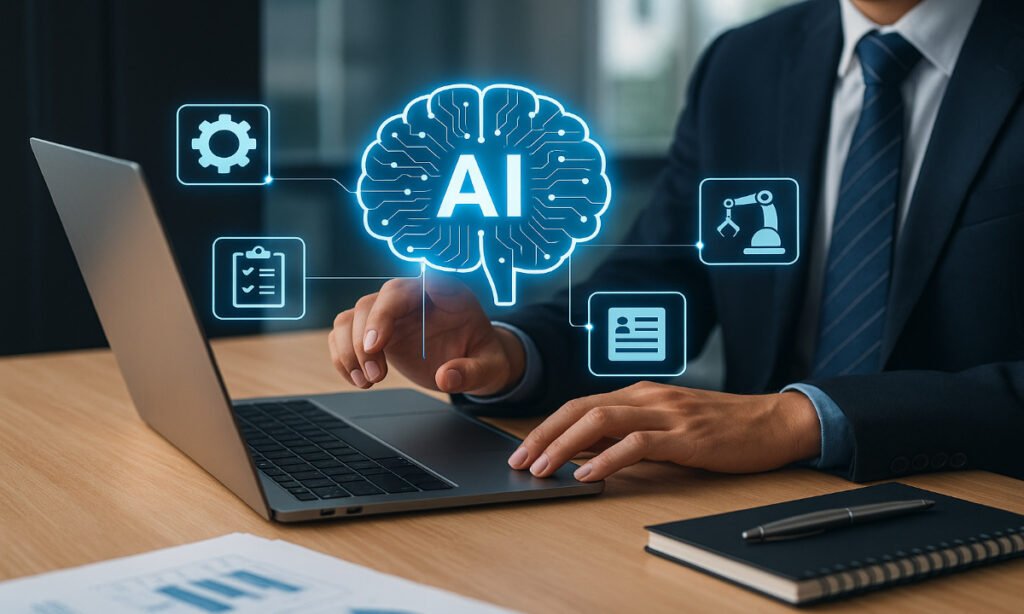
Understanding the Power of Generative AI in Enterprises
Generative AI is based on sophisticated machine learning models that can generate text, code, images, designs, and even business plans. Since it can learn patterns from huge datasets, its outputs can simulate human thinking and creativity. In enterprise automation, AI serves at least three critical functions:
1. Intelligent Content Creation
Businesses depend on quality content for marketing, documentation, customer communications, and product management. AI can be used to automatically create:
- Product descriptions
- Reports and summaries
- Marketing copy
- Technical documentation
- Customer emails and responses
This not only dramatically reduces manual work but also improves cross-departmental consistency.
2. Automated Decision-Making
Generative AI can process data, recognize patterns, predict results, and assist in automated decision-making. It allows for quicker and more precise decisions, from predicting sales to managing inventory and uncovering risks.
3. Workflow Optimization
Complete workflows, including HR onboarding, financial reconciliation, procurement approvals, and IT service management, can be fully automated by enterprises. AI orchestrates tasks, interprets dependencies, and initiates activities automatically.
4. Code Generation & Software Automation
The world of software is being turned on its head: now, AI is not just producing code, but also productizing code, automating debugging, producing tests, and documenting systems. It compresses development timelines and enables groups to lead with fresh thought.
5. Customer Service Automation
AI-enabled chatbots and virtual assistants can now comprehend context, provide intelligent responses, and solve customer problems in an instant. AI brings greater personalization, accuracy, and speed of response.
Also read- Quantum Computing & Quantum-Driven Innovation
Why Generative AI Is Transforming Enterprise Automation
Generative AI enables enterprises to transition from manual and partially automated systems to full automation in processes. Here are its differentiators:
1. Creativity + Automation
AI is different from traditional automation, as it can do more than just repetitive tasks. It can think, create, and solve problems, allowing automation to become smarter and more flexible.
2. Scalability and Efficiency
Companies can scale their businesses without increasing their teams. Processes that necessitated strenuous️ manual effort can now be automated to a startling degree of precision and velocity.
3. Cost Reduction
Reducing the manual workload and streamlining processes with intelligent automation, AI leads to a significant cost reduction for operations across the board.
4. Improved Accuracy
With more data-driven insights, Generative AI minimizes errors in reports, customer interactions, analytics, and coding.
5. Faster Time-to-Market
From launching campaigns to developing software to creating documentation, AI delivers a significant speed-up in outcomes.
Real-World Applications of Generative AI in Enterprise Automation
1 Marketing & Sales Automation
Generative AI enables campaign creation, content scheduling, social media strategy, and customer segmentation to be fully automated. It can also predict behavior and send hyper-personalized communications.
2 Finance & Accounting Automation
AI insights and automated processes complement and enhance workflows for invoice processing, financial forecasting, budget planning, risk analysis, and audit reporting.
3 HR & Talent Management
It’s not just helping screen resumes or write job descriptions; it can also be used to automate certain onboarding processes, perform sentiment analysis and improve strategies for employee engagement.
4 IT Operations (AIOps)
- Generative AI can:
- Predict system failures
- Analyze logs
- Automate ticket resolution
- Generate scripts
- Give automated answers to routine IT issues
That means less downtime and better service.
5. Legal & Compliance Automation
Generative AI can also analyze regulations, create contracts, summarize legal materials, and file compliance reports.
6. Manufacturing & Supply Chain
Thus, it enables predictive maintenance, supply-demand prediction, production scheduling, and transport administration.
7. Customer Service Personalization
From automated emails to scripted calls by AI, Generative AI helps shape user experience with context-aware answers.
Also check- What is qkfzzu1lbnvinhp4dlhz Understanding the Mysterious Code
Benefits of Using Generative AI in Enterprise Automation
1. Productivity Boost 2.0
Now they can delegate the more tedious of tasks and be able to focus on the more strategic work.
2. Better Accuracy and Consistency
The content and decisions produced by AI are consistent throughout the organization.
3. Continuous Optimization
Generative AI continually adapts workflows based on learning from streaming data.
4. More Engaged Employees
Instead of wasting their days on repetitive tasks, workers have more time to be creative, innovative, and solve problems.
5. Staying Ahead of the Curve
Those enterprises that become early adopters and pioneers in applying Generative AI will gain speed, agility, and technology leadership.
Challenges to Consider
And while Generative AI holds much promise, it also brings challenges, such as:
- Risks to data privacy and compliance
- Over-reliance on automated systems
- Requirement for high-quality training data
- Biases in the output generated
- Employees face barriers to adoption
Enterprises should provide a robust governance model, preserve transparency, and ensure responsible AI application usage.
FAQs
1. What are the benefits of Generative AI in enterprise automation?
The main advantage is that it can automate routine as well as imaginative work, thereby enhancing productivity and decision-making speed.
2. What are the best use cases for the departments in Generative AI?
Marketing, HR, finance, IT operations, customer support and supply chain management are also significantly affected.
3. Can I trust Generative AI in the enterprise?
Yes, when used with appropriate data governance, privacy safeguards, and audit capabilities.
4. Is Generative AI able to integrate with enterprise systems?
Definitely. Most enterprise software products have integrated AI or have exposed APIs that can be used to create automation.
5. Does Generative AI replace people who work?
It will not replace people but enable them to automate monotonous tasks and focus on strategic and creative work.
Conclusion
Generative AI is now the foundation for enterprise automation. It’s changing how businesses operate, with the “way it understands context, creates content, optimizes workflows and strategic decision making,” Intuition Robotics’ gal says. As enterprises adopt digital transformation, Generative AI is a competitive advantage based on efficiency, accuracy, and cost reduction. Early adopters of Generative AI are set to lead the next wave of enterprise innovation, transforming potential into new benchmarks of productivity and growth.