The development of software is about to become a whole lot easier. Classic programming — the sort where developers mush their fingers across the keyboard and bang out lines of code, correct bugs, audit syntax, and over time acquire a deep understanding of how everything within a given language works — is in the middle of a massive evolution. At the heart of this shift is Vibe Coding: The New Way Developers Build Software. Developers are trading in writing lines of code for typing natural-language instructions in this new paradigm, benefiting from focusing on ideas rather than syntax.
Vibe Coding is rapidly becoming one of the biggest transformative shifts in how software is developed, tested, and released. Driven by generative AI, rather than coding, the developer describes what they want; the AI writes the code, adds the logic, and runs the code. Instead of looping or variables or structures, developers just “vibe” with the problem — trading in discussion, reaction, and trying things out.
In this post, we’ll discover what Vibe Coding is, how it works, why it matters, and how the future of software development looks under this new paradigm.
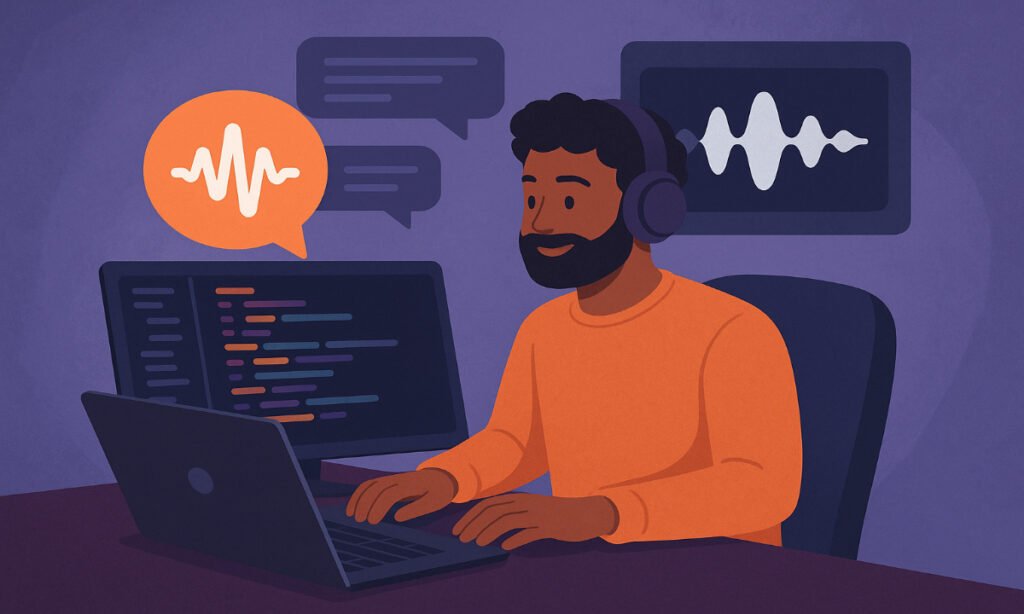
What Is Vibe Coding?
Vibe Coding: How Developers are Using AI to Build Software is a discussion around a new programming model in which developers describe goals, functions, and expected results, while AI systems generate code, test and optimize. Developers describe what they want, and rather than manually specifying how to implement it (through code), the AI automatically generates a working implementation.
See it as the evolution from:
“Write code to conduct an analysis”
to
“Specify the analysis, and let AI write the code.”
Developers still direct the process, but AI agents (plural) create, refine, and debug code based on millions of real-world examples.
Also read- Instanomy: Complete Guide, Risks & Alternatives
How Vibe Coding Works
1. Natural Language
PromptsNow developers talk or write instructions like:
“Make a login page with email and OTP verification.”
The AI translates the query and produces the entire backend and frontend code.
2. Iteractive Feedback Loops
After producing code, the AI says:
“Do you want animations? Use Firebase or custom APIs?”
Developers use verbal or written communication to hone requirements.
3. Executing Code Independently
The AI agents test, run, and debug the code – no more manual terminal work needed. They also suggest upgrades in terms of performance and security.
4. Multi-Model Collaboration
Divergent AI models oversee divergent aspects of development:
- UI/UX layout models
- API structure models
- Database scheme generators
- Security models, and performance optimizers
This is an entirely automated development pipeline.
Why Vibe Coding Is Becoming Popular
1. Accelerates Development Speed
What once took days, now takes minutes. Early prototypes, complex logic, and even full applications can now be quickly created.
2. Makes Access Easier
People who are new to coding can create functional applications simply by writing in natural language.
3. Minimises Boring Work
Developers are no longer spending time typing repetitive code — AI writes it for them.
4. Drives Innovation
As they spent less time worrying about syntax, teams began to think more about innovation and feature development.
5. Real-Time Experimentation
Developers can immediately experiment with variations on their ideas — and with a handful of options to choose from, they can select the best solutions.
Also check- Amandalaviinia: Meaning, Origins & Creative Influence
Key Features of Vibe Coding
1. Conversational Programming
You talk to the AI the same way you tell a teammate what you want.
It’s simple to use, intuitive, and a whole lot quicker.
2. Automatic Code Refactoring
Unnecessary rows are removed, structures are refined and well-performing code is guaranteed.
3. Smart Debugging
Before the user even notices them, AI hunts down bugs. The interface describes problems in laymen’s terms and provides a few different solutions.
4. Multi-Language Compatibility
If you want Python, JavaScript, C#, or Kotlin, the AI can write and convert code on the spot.
5. End-to-End Application Building
Database configuration to UI design to backend logic — you can build it all with AI models.
Real-World Applications of Vibe Coding
1. Startups & Rapid Prototyping
Entrepreneurs can build MVPs at a breakneck speed without needing to hire too many engineers.
2. Enterprise Automation
Organizations can easily automate workflows, build dashboards, and connect internal applications.
3. Education & Learning
Through interaction, students are able to learn programming concepts as opposed to memorizing syntax.
4. Game Development
Developers write descriptions for physics, movement, and game logic, then AI automatically generates game mechanics.
5. Web & App Development
Complete-stack applications can be developed with conversational commands.
How Vibe Coding Impacts Developers
1. Developers Become Architects
They don’t write code line by line, they design solutions, strategies, and systems.
2. Enhanced productivity
Teams can now deliver in days what would have taken months.
3. Evolution of Skills
It’s more important to think logically, solve problems and understand architecture than be able to write a lot of code.
4. Collaboration With AI Agents
Developers work with AI models as intelligent teammates .”
Challenges of Vibe Coding
1. Code Quality Verification
Even though AI generates code, humans must still validate logic for mission-critical systems.
2. Dependency on AI Models
Developers must trust that the AI understands their intentions correctly.
3. Security Concerns
Incorrectly generated code could create vulnerabilities if not reviewed.
4. Loss of Traditional Skills
Future developers may rely too heavily on AI and lose deep technical knowledge.
Future of Vibe Coding
1. Complete Autonomous Software Development
Applications will be designed, developed, tested, deployed, and maintained by AI with little human involvement.
2. Emotion-Responsive Coding
Systems may change in response to developer frustration, confusion, or haste.
3. AI-Creation agents tailored to industries specific
In finance, healthcare, gaming, education — industry specific coding AIs will materialize.
4. Multiple Agents Collaborate
Individual AI agents will function like a multi-person engineering team, collaborating.
FAQs
1. What is Vibe Coding?
A new programming paradigm in which developers describe ideas and AI writes the code.
2. Will developers be replaced by Vibe Coding?
No. It frees developers to focus on work that requires human intuition and creativity by automating the rote.
3. Is Vibe Coding suitable for people who are new to coding?
Yes. Building applications isn’t limited to developers anymore, you can also do it with the power of natural language.
4. Are the generated code safe?
It’s trustworthy, but human review is still needed for security.
5. What languages support Vibe Coding?
The most popular (but not all) modern languages like Python, JavaScript, Java, C#, C++, and TypeScript are supported.
Conclusion
Vibe Coding: Developers Construct Software in a Different (New) Way is a new era in programming. Developers are no longer just writing code; instead, they are partnering with powerful AI models that comprehend instructions, write code, test workflows, and improve entire applications. This method not only saves time and enhances creativity, but allows for more people to create complex software without needing to have a background in technology.
As Vibe Coding is further developed, we will be entering a world where software development is more intuitive, expressive, and accessible. The future of coding will be conversational, collaborative and AI-driven — and the migration is already underway.